DIR-3 KYC 2026: Deadline, Process and the Penalty for Filing Late
**DIR-3 KYC 2026** simplifies director compliance with a three-year filing cycle and a unified web form. Learn the filing process and deadlines.

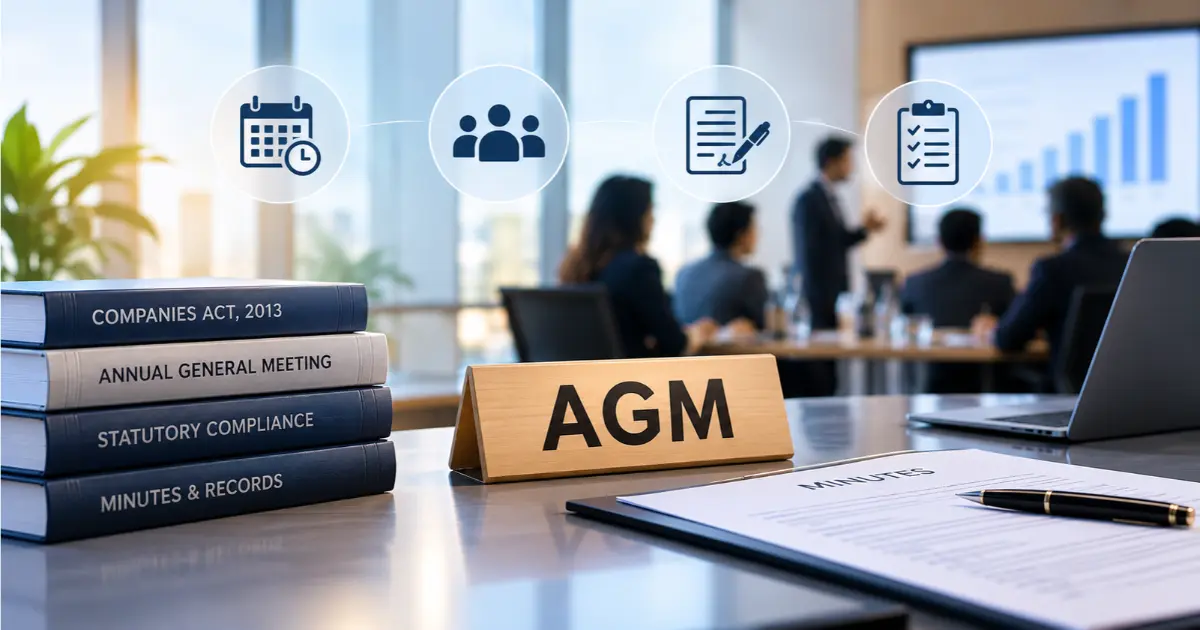
For many founders, the Annual General Meeting is the compliance task that gets pushed to the end of the year. Business is going well, the books are being maintained, and the AGM feels like a formality. Under the Companies Act, 2013, however, it is a mandatory statutory event. Missing a deadline, sending a defective notice, or keeping poor minutes can lead to penalties, ROC filing delays, and awkward questions during due diligence or a bank audit.
This guide covers what every private limited company should know about AGM deadlines, quorum, meeting procedure, documentation and minutes, so you can run a clean, defensible meeting every year.
An Annual General Meeting is a yearly meeting of a company's shareholders. It lets members review the company's performance, approve the audited financial statements, elect or reappoint directors, and appoint auditors. Under Section 96 of the Companies Act, 2013, every company other than a One Person Company (OPC) must hold an AGM each calendar year.
So every private limited company, whether it is a two-person startup or a closely held family business, must hold an AGM, even if all shareholders are also directors and see each other daily. A casual conversation does not count. The meeting must be convened and conducted formally and recorded properly.
An OPC is exempt because it has a single member, and a small company with a few members still has to comply in full.
Timelines are the most common compliance trap, so here are the rules.
First AGM: A company must hold its first AGM within nine months from the closing of its first financial year. If a company was incorporated in August 2025 and its first year ends on 31 March 2026, the first AGM is due by 31 December 2026.
Subsequent AGMs: Later AGMs must be held within six months from the close of the financial year. For the usual 31 March year-end, the AGM must be held by 30 September. In addition, the gap between two AGMs must not exceed 15 months.
Extension: The Registrar of Companies (ROC) may extend the time for holding an AGM, other than the first, by up to three months for special reasons. The application must be made before the due date, so it is not a fallback after the deadline has passed.
Time and place: The AGM must be held during business hours (9 a.m. to 6 p.m.) on a day that is not a national holiday. It may be held at the registered office or at another place within the city, town or village where the registered office is located.
If your due date has passed and you have not held the meeting, act now rather than waiting for the next financial year. Late compliance is cheaper than prolonged default.
A valid meeting starts with a valid notice. Under Section 101, a company must give at least 21 clear days' notice in writing or through electronic mode. "Clear days" excludes the day the notice is sent and the day of the meeting.
Shorter notice: An AGM can be called at shorter notice if not less than 95% of the members entitled to vote consent in writing or electronically. Keep that consent on record.
Who receives the notice: Every member, every director and the statutory auditor. Auditors are entitled to attend and be heard on matters concerning them.
What the notice must contain:
Common errors include a notice shorter than 21 clear days, omission of the explanatory statement, and failure to send it to all members. Any of these can make the proceedings open to challenge.
Quorum is the minimum number of members who must be present for the meeting to transact business. Under Section 103, the quorum for a private limited company is two members personally present, unless the Articles of Association prescribe a higher number. Check your Articles, because some companies, especially those with investor-backed shareholder agreements, set a stricter requirement.
Key points to remember:
For companies with a single active member holding all or nearly all shares, take advice early, because a poorly planned shareholding structure can make quorum difficult to achieve in practice.
A well-run AGM is simple, but each step matters.
1. Board meeting before the AGM. The Board approves the financial statements and the Board's report, authorises the notice, fixes the AGM date, time and venue, and approves the list of items on the agenda.
2. Dispatch the notice. Send the notice along with the annual financial statements, the Board's report and the auditor's report at least 21 days before the AGM. Maintain proof of dispatch.
3. Appoint the chairman. As per Section 104 and the Articles, the chairman of the Board usually presides. If the chairman is absent, the members present elect a chairman.
4. Confirm quorum and take attendance. The chairman declares the meeting open once quorum is present. Members, directors and the auditor sign the attendance register.
5. Transact the agenda. Ordinary business typically includes:
Any other item is special business, such as altering the Articles, approving related party transactions or increasing authorised capital, and requires an explanatory statement in the notice.
6. Voting. Ordinary resolutions need a simple majority and special resolutions need at least 75% of votes cast in favour. Voting is first by show of hands and, where demanded, by poll. Members may vote through proxies, subject to the proxy form being deposited at least 48 hours before the meeting.
7. Close the meeting. The chairman thanks the members and declares the meeting closed.
Companies may hold meetings through video conferencing or other audio-visual means where permitted. MCA has issued circulars on this over the past few years, so confirm the position that applies at the time you plan your AGM.
Good documentation is the best protection against disputes and penalties. Maintain the following:
Keep these in a dedicated compliance folder for each financial year. If the ROC, an investor or a due diligence team asks for AGM evidence three years later, you will be glad you did.
Minutes are the official record of what happened at the meeting. Section 118 of the Companies Act and Secretarial Standard 2 (SS-2) on General Meetings govern them, and they are the first thing an auditor or investor will examine.
What minutes should contain:
Rules for recording:
A common mistake is to treat minutes as an afterthought, drafted months later from memory. Prepare a draft promptly while the details are fresh.
Holding the meeting is only half the compliance. After the AGM, file the following with the ROC:
Late filing attracts additional fees for each day of delay, and these can quickly exceed the original filing cost.
Failure to hold an AGM on time attracts penalties under Section 99 of the Companies Act. The company and every officer in default are liable to a fine, with further daily penalties for continuing default. Late or missed annual filings under Sections 92 and 137 carry separate penalties for both the company and its officers, along with the ROC's additional filing fees. Persistent default can also bring disqualification of directors and, in serious cases, the company being marked for strike-off.
Penalty amounts and procedures can change through amendments and decriminalisation measures, so verify the current position before relying on any figure, or check with a professional.
Can a private limited company hold the AGM at a short notice? Yes, if not less than 95% of the members entitled to vote give consent in writing or electronically.
Is a physical meeting compulsory? Not always. Video conferencing or other audio-visual means can be used where permitted by the Act, the rules and MCA circulars. Check the current rules before deciding.
Can the AGM be held by circular resolution? No. An AGM must be an actual meeting, though other matters may be approved by resolution by circulation.
Do dormant or inactive companies need an AGM? Yes. A company with no business activity still has statutory obligations, including the AGM and annual filings.
An AGM is more than a ritual. When it is planned properly, with a timely notice, a valid quorum, a clear agenda and accurate minutes, it protects your company, your directors and your shareholders. Build a compliance calendar at the start of each financial year, set reminders for the Board meeting, the notice dispatch, the AGM itself and the ROC filings, and keep your records organised.
Disclaimer: This article is for general information and is not legal advice. Compliance requirements can change, so consult a qualified professional for your company's specific situation.
Need help with your AGM and annual ROC compliance? Mambiz Solutions handles everything from drafting notices and board resolutions to preparing minutes and filing AOC-4 and MGT-7, so you never miss a deadline or a penalty. Talk to our compliance experts today and get a clear, hassle-free AGM process for your private limited company.
👉 Contact Mambiz Solutions at mambizsolutions.com for a free consultation.
**DIR-3 KYC 2026** simplifies director compliance with a three-year filing cycle and a unified web form. Learn the filing process and deadlines.
The yearly filings every private limited company must complete, and what happens if you miss them.
LLP registration in Bangalore: Learn the process, costs, required documents, legal formalities, annual compliance, and key requirements for starting an LLP.