
Annual ROC compliance checklist for private limited companies
The yearly filings every private limited company must complete, and what happens if you miss them.
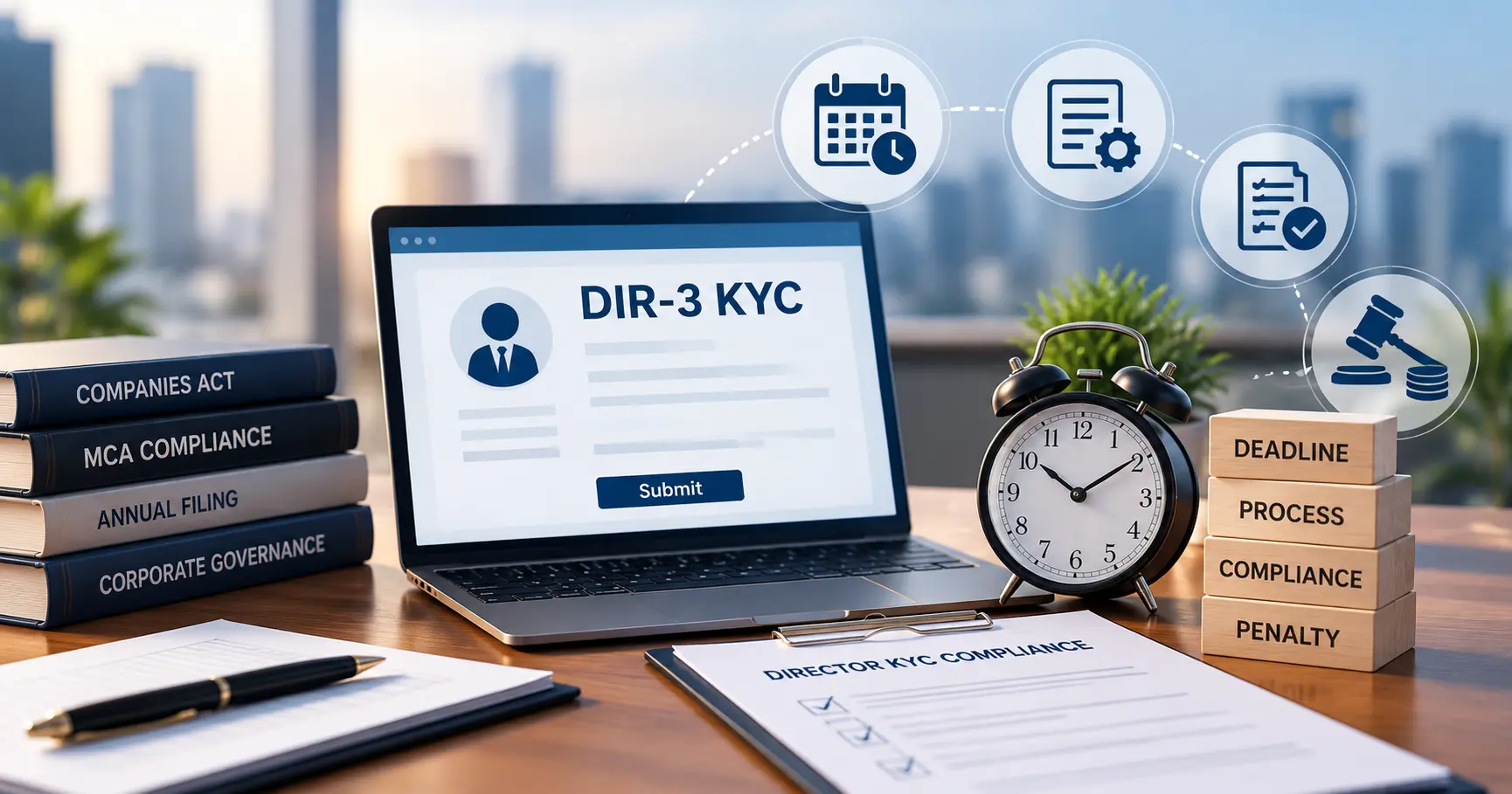
If you hold a Director Identification Number (DIN), DIR-3 KYC is one of the most important compliance tasks on your calendar. It is also one of the easiest to forget. For years, directors had to complete it every single year. The rules changed in 2026, and many directors are now unsure when their next filing is due, which form to use, and what happens if they miss the date.
This guide covers the new DIR-3 KYC framework, the deadline, the filing procedure, the compliance requirements, and the cost of filing late.
DIR-3 KYC is the Know Your Customer-style verification that every individual holding a DIN must complete with the Ministry of Corporate Affairs (MCA). Rule 12A of the Companies (Appointment and Qualification of Directors) Rules, 2014 mandates it.
Through this filing, a director confirms or updates the personal details linked to their DIN, mainly:
The MCA uses this data to keep the director database accurate and to make sure notices and communications reach real, reachable people. It also helps weed out inactive or untraceable directors. That is why the requirement applies to every DIN holder, whether or not the person is currently on the board of an active company.
The rule is broad. You must comply if:
In short, an approved DIN means a KYC obligation. A common misconception is that resigning from a company ends the duty. It does not. The obligation attaches to the DIN, not to the directorship.
The biggest development is the change in filing frequency. Under the earlier framework, every DIN holder had to complete KYC every financial year by 30 September, and later by 30 June. In late 2025, the MCA notified an amendment to Rule 12A, effective from 31 March 2026, that replaces the annual requirement with a triennial one. Directors now file once every three consecutive financial years.
The amendment also simplified the forms. Earlier, there were two:
These have been merged into a single Form DIR-3 KYC Web. This reduces confusion over which version to file.
If you complete your KYC in a given cycle, you do not need to file again in the intervening years. For example, a director who files during FY 2025-26 would next be due by 30 June 2028. The date is worked out from your last valid filing and the third financial year that follows.
A caution: your exact due date depends on when your DIN was allotted and when you last filed. Several directors have miscalculated it. The MCA portal displays the KYC status for each DIN, and you should confirm the date there rather than relying on a self-calculated one.
The key points are:
Because rules and circulars can change, a periodic check of the MCA portal or a quick call to your compliance advisor is the safest approach.
DIR-3 KYC Web is a light, OTP-driven process, but a few things need to be ready:
Check that the mobile and email on file are active. If you have changed either one, update them first, or you will not receive the OTPs.
Below is the standard online procedure through the MCA21 portal.
Step 1: Log in to the MCA portal.
Visit the MCA website and log in with your user ID and password. If you are not registered, create a user profile first.
Step 2: Navigate to the service.
Go to MCA Services → DIN Services (or Company e-Filing → DIN Related Filings) and choose DIR-3 KYC Web.
Step 3: Enter your DIN.
The system fetches the details attached to your DIN, including name, PAN, mobile number and email.
Step 4: Verify through OTP.
Two separate one-time passwords are sent, one to your registered mobile number and one to your email. Enter both to confirm that the contact details are valid and in your control.
Step 5: Review and update details.
If nothing has changed, simply confirm. If your address or other particulars have changed, update them and attach supporting documents as prompted.
Step 6: Pay the fee, if applicable.
Filing on or before the due date attracts no government fee. A late filing does. Complete the payment online.
Step 7: Submit and save the acknowledgement.
After submission, download the acknowledgement and the SRN (Service Request Number). Keep these on file as proof of compliance. The MCA usually processes the request quickly, and your DIN status updates accordingly.
If you also need to change details outside your regular cycle, the amended rules allow a fresh DIR-3 KYC Web filing for that purpose. Do not wait for your next triennial date to update a stale address, because outdated records are the main reason directors miss official notices.
Missing the deadline sets off a chain of consequences, and the money is only one part.
Once the due date passes without filing, the MCA marks your DIN as “Deactivated due to non-filing of DIR-3 KYC.” A deactivated DIN is effectively frozen.
A director with a deactivated DIN cannot be named as a signatory on e-forms filed with the Registrar of Companies. This can block routine filings such as annual returns, financial statements, director appointment forms, and other statutory submissions. The company’s compliance calendar suffers even though the lapse belongs to the individual.
To restore a deactivated DIN, the director must file the DIR-3 KYC Web form and pay the applicable government filing fee. The same fee may apply when the form is submitted after the due date, whether or not the DIN has already been deactivated.
The fee structure for DIR-3 KYC Web has been revised, with different charges depending on whether the filing is completed on time, submitted late, or filed again to report changes in details. Directors should confirm the applicable fee on the MCA portal at the time of filing.
Technically, this is a government filing fee rather than a penalty. However, it is still an avoidable cost when the KYC filing is completed within the prescribed deadline.
The late fee is not the end of the story. Rule 12A is a statutory obligation, and non-compliance can attract further action by the Registrar. Recent adjudication orders issued by Registrars of Companies have imposed monetary penalties on directors and companies for failing to file DIR-3 KYC, in some cases running into tens of thousands of rupees or more per case. The size and the likelihood of such penalties depend on the facts, the length of default, and the adjudicating officer, but the risk is real, particularly for repeated or prolonged defaults.
A frozen DIN can delay a board appointment, hold up a funding round, complicate due diligence and create friction with banks and investors. For a startup in the middle of a fundraise or an MSME applying for a loan, this is a serious setback for what is, at heart, a ten-minute filing.
Use this quick list to stay on the right side of the rules:
Although DIR-3 KYC is an individual obligation, its impact spills over to the company. Founders and company secretaries should:
A small tracker in a spreadsheet or compliance tool saves a lot of last-minute scrambling.
Missing a DIR-3 KYC date usually comes down to a simple lack of tracking, not a lack of effort. At Mambiz Solutions, we handle director compliance end-to-end so that you can focus on running your business. Our team can:
The 2026 amendment has simplified the DIR-3 KYC process by introducing a unified web form and extending the filing cycle to three years. This reduces the frequency of compliance for directors. However, the consequences of missing the applicable deadline remain significant.
A deactivated DIN can prevent directors from signing documents and completing MCA filings. Reactivation may involve a ₹5,000 fee and could also lead to further action by the Registrar.
To stay compliant, directors should verify their due date on the MCA portal, keep their contact details and DSC up to date, complete the filing within the prescribed timeline, and retain the acknowledgement for future reference. Businesses can also work with a compliance professional to manage these requirements efficiently.
Is your DIN at risk of deactivation? Don’t wait for the deadline to pass.
Let the compliance experts at Mambiz Solutions check your DIR-3 KYC status, file your return accurately, and keep your DIN active, so that you never pay a late fee.
👉 Get Your DIR-3 KYC Filed Today | Talk to Our Compliance Team
The yearly filings every private limited company must complete, and what happens if you miss them.
LLP registration in Bangalore: Learn the process, costs, required documents, legal formalities, annual compliance, and key requirements for starting an LLP.
GSTR-1 vs GSTR-3B: Understand key differences, filing deadlines, common mismatches, GST notices, and practical ways to stay compliant.