How a Jayanagar Bakery Chain Secured Its Trademark After an Examination Objection
Jayanagar bakery’s trademark objection: why examiners object, how to file a reply, and how to track it to registration in India.

A brand name can be chosen in a week and challenged for years. Many Indian founders pick a name, print packaging and launch a website, and only then find a similar mark already on the register. By then a rebrand is costly, and an objection or opposition becomes a real possibility.
A trademark search India applicants run before filing is the cheapest way to see that risk early. It cannot guarantee registration, because that decision rests with the Registrar and with any third party who opposes, but it stops you filing blind. This guide shows how to check trademark availability using official IP India resources, how to read what you find, and what to do next. If you are still choosing a name, read why you should file your trademark before you launch alongside it.
A trademark search is a structured check of existing records to see whether your proposed name, logo or slogan is identical or similar to marks already applied for or registered for the same or related goods and services. The register is maintained by IP India; see its basics of trademarks page for background.
The aim is not just to find an exact match. Under the Trade Marks Act, 1999, a mark can be refused or opposed if it is deceptively similar to an earlier mark, meaning it so nearly resembles that mark as to be likely to deceive or cause confusion (Section 2(1)(h)). A useful search therefore looks at spelling, sound, meaning and class. It shows risk; it does not replace the examiner's own assessment.
Use this sequence for any name, logo or tagline. Keep dated notes as you go.
|
Step |
What to do |
Why it matters |
|
1 |
Fix the exact mark: name, logo, tagline and any variants you plan to use. |
You can only judge conflict against a clearly defined mark. |
|
2 |
List your goods or services and map them to Nice classes. |
Conflicts are judged by class and by how related the goods or services are. |
|
3 |
Search the exact name on IP India's public search. |
Catches the obvious conflicts first. |
|
4 |
Search variations: spelling, spacing, plurals, abbreviations and Indian-language words written in English letters. |
Objections arise from similar marks, not only identical ones. |
|
5 |
Check phonetics and meaning: say it aloud and consider translations. |
Marks that sound or mean alike can still confuse buyers. |
|
6 |
Search related classes, not just your main one. |
A food brand, for example, may touch classes 29, 30, 35 and 43. |
|
7 |
If you use a logo, check figurative elements using the Vienna classification. |
Device marks are compared visually as well as by name. |
|
8 |
Note the owner, class, goods or services and status of each similar entry. |
Status shows whether a conflict is live. |
|
9 |
Record the date, search terms and findings, then decide: proceed, modify, or take advice. |
Gives you a clear basis for the filing decision. |
IP India offers a public search tool for the trade marks database at the Trade Mark Public Search portal. When we reviewed it, the portal asked for an OTP-based sign-in and a captcha, and linked to supporting pages such as Class Details, Well Known Marks, Vienna Code Classification and Help. IP India also lists an AI/ML-based search tool and a trade mark status page for tracking an application you already know of. IP India's page on searching existing trademarks before you apply is a good starting point.
Portal screens and search options change, so follow the options currently shown on screen rather than a fixed click-path from any blog, including this one. Begin with the name alone, then work through variations, and note the class and status of every similar entry.
Suppose you plan a cold-pressed juice brand called FreshNest. Do not stop at that spelling. Also try Fresh Nest, FreshNesto and FreshNex. These are fictional names used only to illustrate the method; they are not real records.
For each similar entry, note who owns it, which class it sits in, what it covers and its status. A close name in class 32 (non-alcoholic beverages) deserves close attention. The same name in an unrelated class may matter less, though well-known marks can receive wider protection, so check IP India's list of well-known trade marks too.
Examiners and opponents rarely ask only whether two marks are identical. They ask whether an average buyer with imperfect recollection could be confused. Check each mark on three fronts.
|
Test |
What to compare |
Illustrative example (fictional) |
|
Visual |
Spelling, length, word order, logo shape and colour |
FreshNest vs FreshNex: one letter apart |
|
Phonetic |
How the marks sound when spoken |
FreshNest vs Fresh Nesto: near-identical sound |
|
Conceptual |
The idea or meaning the mark suggests |
FreshNest vs NewNest: both suggest a new, fresh home |
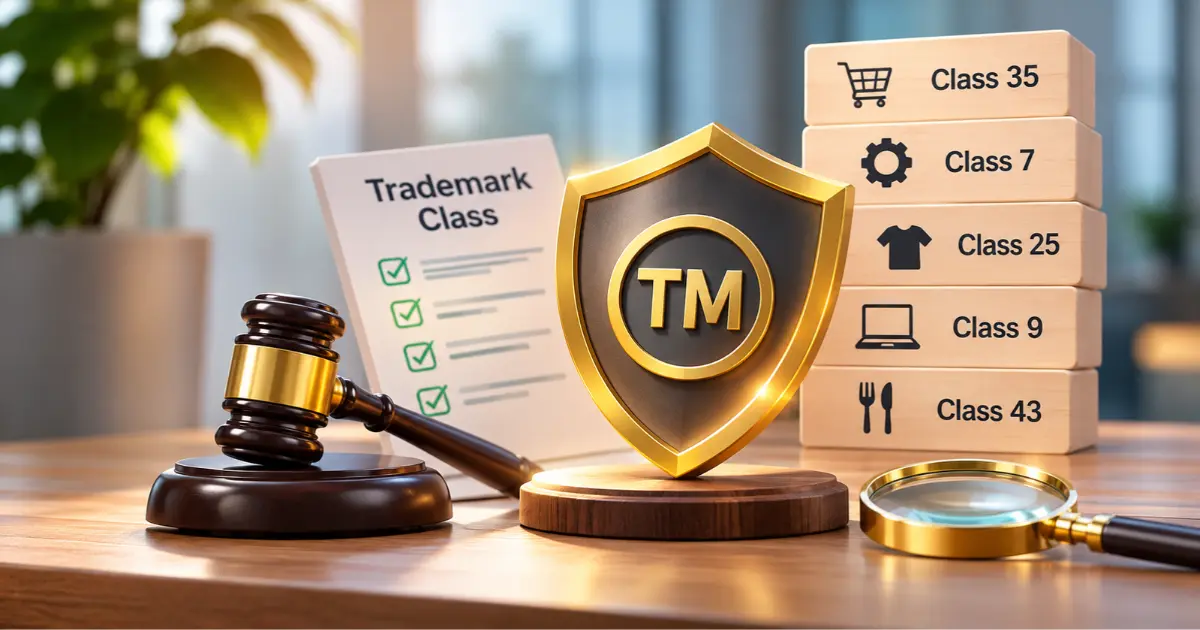
Marks are registered for specific goods and services under the Nice Classification: classes 1 to 34 cover goods and 35 to 45 cover services. A name may be free in one class and blocked in a related one. Browse the WIPO Nice Classification and its online publication, or read our guide to trademark classes in India. A single application can cover several classes, with the fee payable for each class (Section 18(2)).
|
Business |
Classes to check |
Typical items (confirm against the current Nice listing) |
|
Bakery or snack brand |
30 (also 29, 35, 43) |
Bread, biscuits, tea, coffee, spices, snacks |
|
Packaged dairy or processed foods |
29 (also 30, 35) |
Milk products, edible oils, processed fruit and vegetables |
|
Online store or retail |
35 |
Retail and online store services, advertising, business management |
|
Café or restaurant |
43 (also 30, 35) |
Restaurant, café and catering services |
|
App or software product |
9 (also 42, 35) |
Downloadable software and mobile apps; software as a service falls in 42 |
|
Clothing label |
25 (also 35, 18) |
Clothing, footwear, headgear; retail of apparel in 35 |
|
Juice or beverage brand |
32 (also 35, 43) |
Non-alcoholic beverages, fruit juices |
Every similar entry needs two questions answered: is it in a related class, and what is its status? Status labels on the portal may be worded differently from the table below, so read each entry as it appears and treat this as a guide only.
|
Status you may see |
Broad meaning |
How to treat it |
|
Registered |
Entered on the register for stated goods or services |
Serious conflict if similar and related; consider changing the mark or taking advice |
|
Accepted and advertised |
Cleared examination and published for opposition |
A live earlier right; monitor it |
|
Pending or under examination |
Filed, awaiting or undergoing examination |
Can still be cited against you; not a clear field |
|
Objected or opposed |
Examination objection raised, or a third party has challenged it |
Outcome uncertain; do not assume it will fall away |
|
Refused, abandoned or withdrawn |
Application did not proceed |
May lower risk, but confirm the current status before relying on it |
• Change the mark. Adding a distinctive element or choosing a fresh name is often cheaper than contesting a conflict.
• Narrow the scope. If your goods genuinely differ, a tighter list of goods or services may help, but it is not a cure for a close mark.
• Re-check the status. An abandoned or refused entry may be less of a barrier; confirm before relying on it.
• Explore consent or assignment. You may approach the owner, though the Registrar still examines your application independently.
• Take professional advice. The Act recognises honest concurrent use in limited cases (Section 12), but that is a legal argument, not a plan. MAM Biz Solutions can walk you through the options within its trade mark registration service.
• Searching only the exact name and ignoring spelling, sound and meaning.
• Checking one class when related classes also matter.
• Skipping the logo or device elements of the mark.
• Treating a clean result as a promise of registration.
• Confusing an application number with a registration.
• Failing to record the search date, terms and findings.
• Printing packaging and launching before searching.
Refusals mostly fall into two groups. Absolute grounds (Section 9) concern the mark itself, for example if it is devoid of distinctive character or merely describes the goods. Relative grounds (Section 11) concern earlier rights: a likelihood of confusion or association with an earlier mark, well-known marks, and passing-off style conflicts.
A search mainly helps with relative grounds, and it also shows whether a name looks too descriptive. It lowers avoidable risk. It cannot remove the chance of an examination objection or an opposition, so plan for both. If an objection arises, this bakery chain's experience shows how one applicant approached it.
Once you are comfortable with the result, the usual path is below. Confirm current requirements and fees on IP India's filing process and forms and official fees pages; our registration walkthrough covers the same journey.
1. Run a final search close to the filing date.
2. Confirm the classes and the goods or services description.
3. Decide the applicant: individual, proprietorship, LLP or company.
4. Prepare the mark representation and applicant details.
5. File the application in Form TM-A through IP India's e-filing system.
6. Note the application number, which is not a registration.
7. The application is examined by the Registrar.
8. Reply to any examination report within the time allowed.
9. Attend a hearing if one is called.
10. The accepted mark is advertised in the Trade Marks Journal.
11. A three-month opposition window follows, extendable by up to one month (Section 21); a counter-statement is due within two months of an opposition notice.
12. If unopposed or the opposition fails, the mark is registered (Section 23).
MAM Biz Solutions helps applicants move from a shortlisted name to a filed application through its trade mark registration service. Where the applicant entity is not yet set up, it also offers company registration, LLP registration and proprietorship services, so applicant details are settled before filing. Learn more about the team or use the contact page to discuss your name.
• Exact mark, logo and tagline defined.
• Goods and services mapped to Nice classes, including related classes.
• Exact-name search done on IP India's tools.
• Spelling, phonetic and meaning variations checked.
• Logo elements checked where relevant.
• Status, owner and class noted for every similar entry.
• Well-known marks list reviewed.
• Results dated and saved.
• Decision recorded: proceed, modify or take advice.
• Search repeated shortly before filing.
A name is only an asset if you can keep using it. A careful search will not guarantee registration, but it gives you the facts to file with your eyes open, adjust the mark early and avoid expensive surprises. Start with the official tools, keep your records, and explore more in our trademark articles.
It is a check of existing trademark records to see whether your proposed mark is identical or similar to marks already applied for or registered for the same or related goods and services.
A prior search is not a filing requirement, but it is a sensible way to spot conflicts and avoid avoidable objections or opposition.
Yes. IP India provides a public search portal and an AI/ML-based search tool. When we reviewed the public search, it used an OTP sign-in, so follow the options shown on screen.
No. The Registrar examines every application, objections can still be raised, and third parties may oppose after publication.
It checks for marks that look, sound or mean something alike, not only identical names, because deceptive similarity can lead to refusal or opposition.
Yes. Conflicts are judged by class and by how related the goods or services are, so search your main class and related ones.
A pending application can still be cited once examined. Treat it as a live risk and consider a change or professional advice.
Sometimes, but related goods, close marks and well-known marks can still create conflict. Assess each case individually.
No fixed period can be promised. It depends on examination, any objection or hearing, publication and whether anyone opposes.
Yes. New applications are filed regularly, so a fresh check close to the filing date reduces the chance of missing a recent entry.
Jayanagar bakery’s trademark objection: why examiners object, how to file a reply, and how to track it to registration in India.
Understand India’s 45 trademark classes, learn how to choose the right class for your brand, and avoid costly filing mistakes before you apply.
A practical guide to trademark registration in Bangalore covering search, TM-A filing, legal requirements, examination, opposition and renewal for businesses.